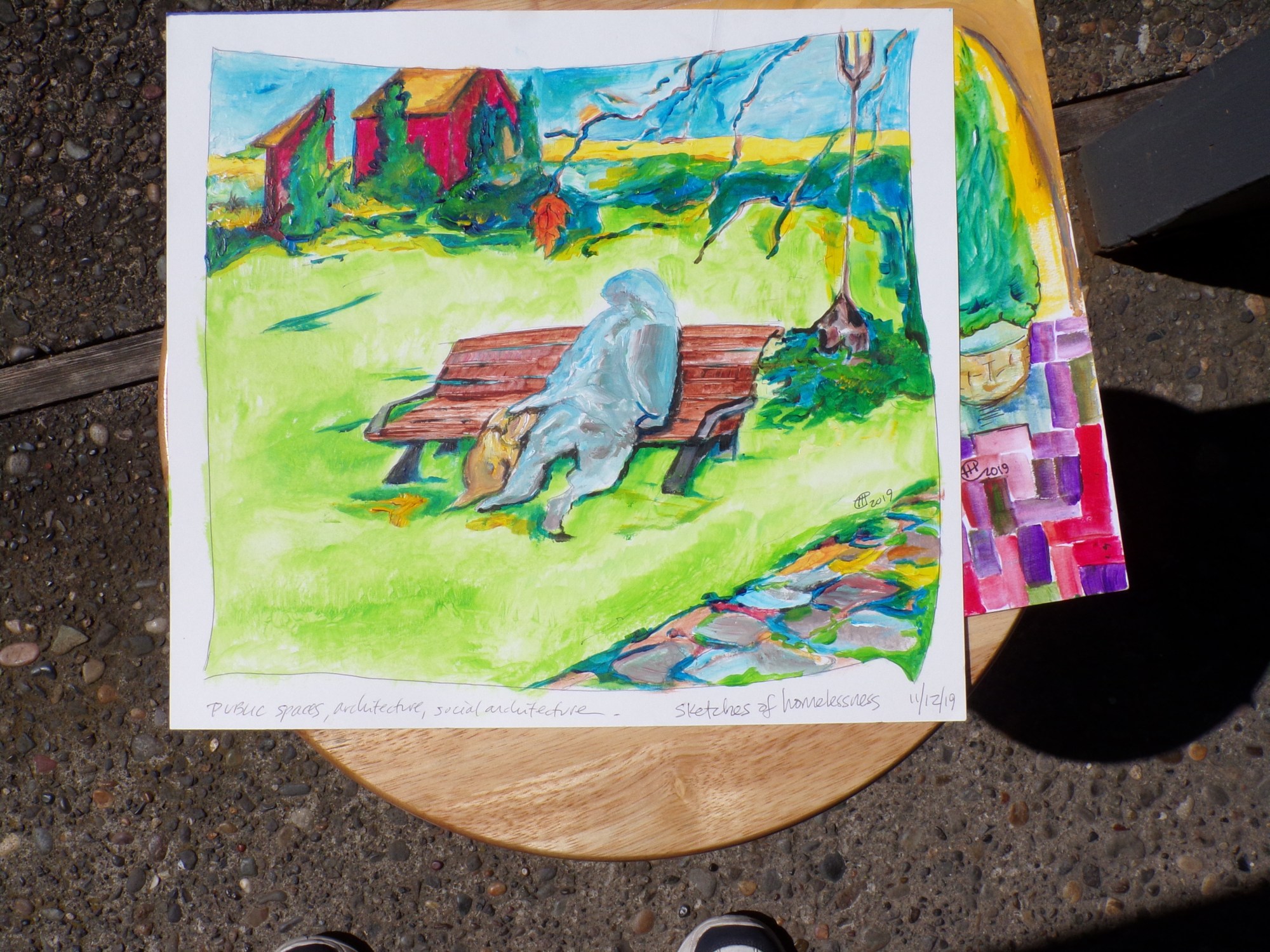
When you walk through a city street and see homeless people, when you ride a city bus and see large immigrant families wearing raggedy clothing and carrying bags from the local food bank, when you see 600 – lb. individuals trying to ride a grocery store cart filled with cakes and chips, what are the first thoughts that come into your mind?
I would like you to consider marginalized persons– including those in and out of incarceration, drug and alcohol treatment, mental health hospitals, those whose highest paycheck is he amount on their disability check, those whose home pantry will not exceed what they can get from their EBT SNAP card, those who look healthy, young and fit but live on social security disability checks and in public housing, those who can’t get their kids into the good schools because they don’t fit the income bracket of the neighborhood — I would like you to go back in time to when these persons were young children.
There is a lot of very robust social science research going on right now on Adverse Childhood Events and adults outcomes of homelessness, addictions, incarceration, learning dysfunctions, mental illness, poverty and unemployment.
Social scientists have used this research to arrive at computation tables that itemizes and scores each adverse child event and show the higher the ACE, the higher the marginalization and disability and poorer health and economy of that person as an adult.
Adverse Childhood Events are basically traumas of early childhood — traumas that are sudden, acute, and intense, like abuse or death of a parent, and those that are more subtle, pervasive, and lingering like food scarcity and addictions.
As my readers know, I am using my own family system to show a number of the effects of trauma and traumatic family dynamics that alter not only the personalities and behaviors of the family members, but the culture of toxicity of the family as a whole.
As you all know, this is the basis for a book I am writing.
So now consider the “Throwaway People.”
I am in that class, and have been for much of my life since childhood, when my older siblings and parents decided to keep the sex abuse from the pedophile uncle Ronald Safsten a secret.
At that time, my family determined that I was expendable. My personhood and health and safety came second, or not at all, in lieu of protecting the sex offender who ate at our table, worked on my sister Diana Hansen’s Hawaii Senatorial campaigns, and was often putin charge of babysitting me.
Long before I was born, my older sister Melanie was sexually molested by Ronald Safsten for years when she was a young child. The family and the Mormon church knew something was going on, but chose to keep that a secret.
When I was two years old, and my older sisters were in their late teens, our family moved to Hawaii for a job offer for my father.
Guess who followed us, but the pedophile Ron Safsten, who was targeting the fresh meat in the cute little toe- head girl Heidi.
If Melanie had told someone in authority that Ron Safsten had molested her for years, and had that adult told the law, I would not have endured his sexual abuse of me.
Had the Mormon church leaders who knew of Ron’s molestations of Melanie told the law, I would have been spared.
And anyone who knows the loud, vocal, bulldozer of a personality of my older sister Hawaii State Representative Diana Hansen, who built her campaign on ”fighting for the little guy, the underdog,” and on holding the “fat cats” in power accountable can not possibly believe that she did not know about Melanie’s sex abuse — they were only about one year apart in age and together all the time. It is not realistic to believe that State Representative Diana Hansen was unaware of her campaign marketing artist Ronald Safsten grooming and abusing me, or that she was unaware that Melanie was being molested by him for ten years right under her nose.
Somewhere in all that time, spanning about 17 years, from being a close-knit, enmeshed mormon family in Bellingham, Washington, to Honolulu Hawaii, this “good mormon politically good” family decided that I was expendable. That I would be the Throwaway.
Later of course, it was Diana who wanted to get her screenplay read by a famous Hollywood producer that she was willing to trade me in to him for some sex time in trade to get her screenplay read by that producer.
By a hair, I escaped the molestation because I already knew what that train looked like on that track and I dodged it.
But when I heard the chillin word’s of Representative Diana Hansen tall me in the hotel elevator, “just don’t tell mom or dad I brought you here, okay?” I knew I was expendable. A throwaway.
So then as a pregnant woman asking my older brother Leif Hansen of Leif’s Auto collission center for protection from my abusive husband Aaron Steweart Heusser one night because he was hurting me and I was worried about the baby inside me, and Leif’s answer was, ” a man’s house is his castle, and a wife belongs in his castle, I can’t take a man’s wife out of his castle.” I knew I was expendable. I was a throwaway.
But I already knew that about Leif, as it was his friend David who took me into Leif’s bed as “man and wife,” while Leif watched with his friends and they all laughed, I knew I was expendable. I was a throwaway.
The only way I got mentally well was to get out of my family as soon as I could as a teenager, cut off all communication with them, and live my life as though they did not exist. I have to do the same thing now, today, at age 56, and the older siblings — the sex abuse enablers — are into old age — cutting myself off from them is again yielding me health, safety, peace, growth, freedom and independence from the grasp of these sociopaths.
If you talk to anyone of these older siblings, they will be all shocked and plather on about how much I was loved, spoiled, doted on as the precious youngest daughter.
But control over a family member is not love.
It is not love to create and maintain a throwaway person.
It is not love to make them mentally ill so that if she ever told about the reality of sex abuse rampant in the family, or domestic violence in her marriage, she would not be credible.
It is certainly not the legal way, the Mormon way — but these are the people who made the laws and saw to their Mormon flock’s needs, and became big business charitable contributers in the community.
Yet they abandoned me to a wife-beater, they abandoned me to a first-class manipulator in court without an attorney, they abandoned me to homelessness on the streets of Vancouver, Washington. Just like they abandoned me to a known pedophile.
They aided and abetted child estrangement by lying for and with Aaron Heusser in his use of child estrangement in an illegal custody play — which is illegal and unlawful at this present time and could mean prison time for them, as well as civil litigation to recoup the damages of parental attachment loss.
These people pretend to be so righteous and the paragon of virtue and success, but in reality, created an expendable person who became society’s throwaway person and represents a reality they go crazy trying to separate themselves from.
But they cannot escape the truths of what they have done and arranged to utilize to protect themselves from being caught. Just create an expendable person to carry that weight for you.
Control is not love. Abuse wrapped up in “This is for your own good,” and “you’ll thank me for this later” while throwing a vulnerable family member under the bus is not love. It is not strength. It is not sane.
Creating a throwaway person and sanctioning more trauma for that expendable person to endure — so they don’t have to face the music of their own behavior — is not love. Not family. Not church. Not safe, not admirable.
It’s immoral, sociopathic, and criminal.
And I’m calling them out.
——————————————–
 the trauma project
Hi, I am a relative of Ronald Safsten. I have been having vivid dreams for the past couple of days relating specifically to him and to child sexual abuse and reading this was kind of haunting. My family has been very very secretive and emotionally closed off for as long as I can remember, and I’ve been scared to ask anyone about what happened. All I’ve known is that something happened related to sexual abuse, he was excommunicated from the church and took it out on his son, and they moved to Utah.
I suffer with CPTSD due to being raised in the LDS church in an emotionally-neglectful family with a cult mentality, traumas of my own, and various struggles with that relating to being a part of the LGBT community. I feel like the family baggage has been swept under the rug for a very long time and it makes me sick to my stomach to think about.
I would love to hear your story and communicate further if you are willing to share.
LikeLike