
This is my painting, “Main & 25th,” which is my former home where I abided for a spell, not un-recently.
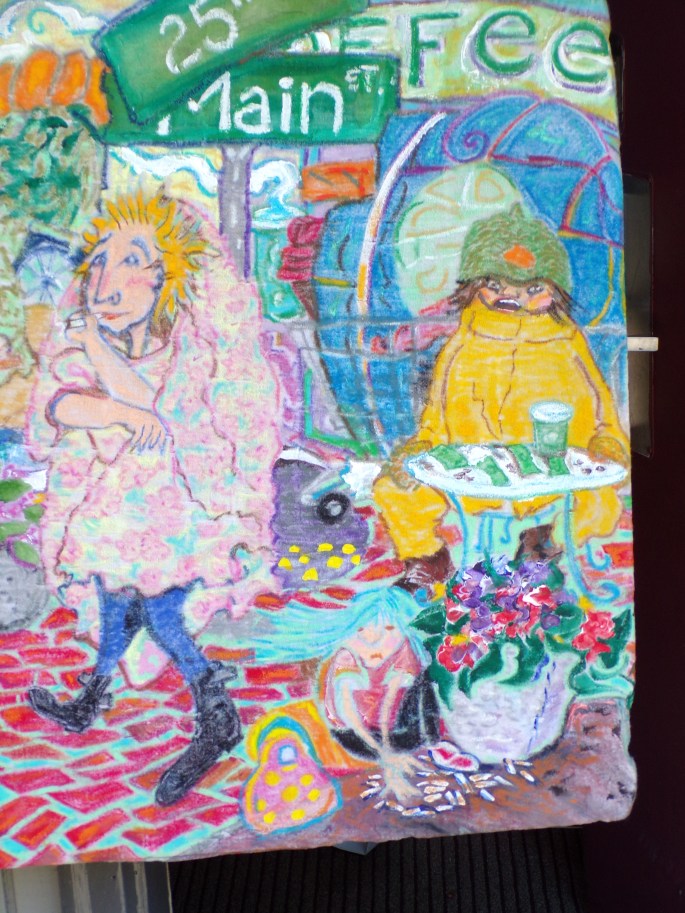
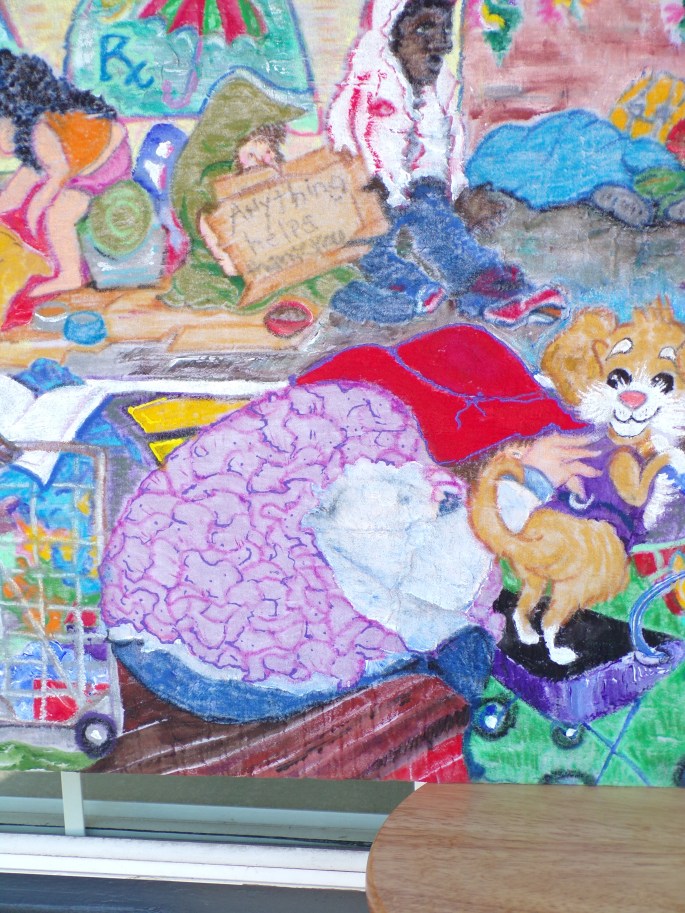
I know the persons in this painting, and painted them with acrylic and pastel on a linen cloth with tenderness and care. I spent days and nights with these folks, and know a bit about their troubles, frustrations, senses of humor, their loves, their aspirations and private griefs.
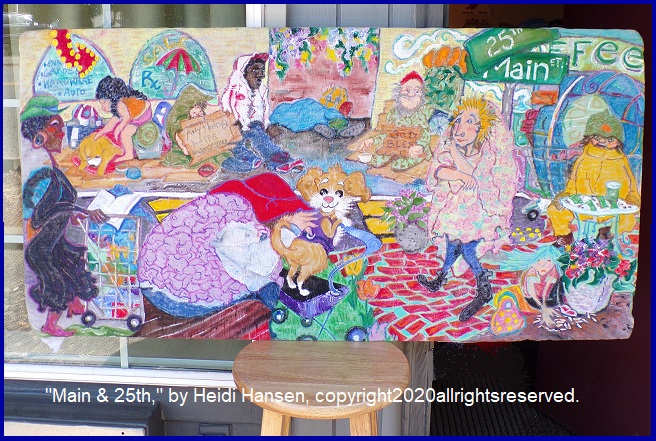
This is the homeless row of downtown Vancouver, Washington, around the corner of Main Street and 25th Avenue. Most ironically, this is where sits the lusciously designed and expensively constructed Vancouver Housing Authority building.
Most of the time, in my experience living on this street, the VHA building is unfrequented by the homeless who live there. Much of the building’s space seemed underutilized to me while I was homeless, and came in to use their restroom and printer. It was also curious to me during this time, that although from various news sources that huge sums of monies had been granted to VHA and Council for The Homeless, For transitional housing, I never saw it going to that, could not figure out where that money was going, and absolutely not one of the persons who work for these and other homeless organizations and city-county government, would not respond to my requests to see the accounting of those funds.
My name is Heidi Hansen, and I was one of these invisible persons, part of the collective Throwaway population of Vancouver’s unresolved homeless culture.
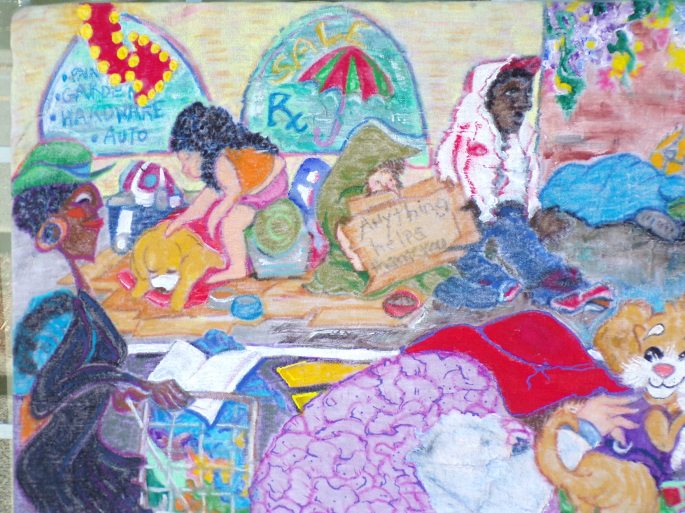
Homeless culture is a sad fact of life, many Vancouver residents and politicians say over and over and over but from what I have seen on the ground, the voters, and persons of credibility and power fail to implement solutions that actually make it different.
In family systems — found in counseling psychology as well as on a macro-level in sociology — when a pervasive and unwanted problem exists in a group and is a continual source of source of problem-solving dialogue and vague attempts at solutions, which fail, we must face ourselves honestly and ask the question “Is this problem actually undesirable? Do Vancouver people really want the homelessness problem to be fixed? Is there secondary gain for keeping the homeless right where they are? Is there some scapegoat value that our society does not really want to give up? And what might that be?””
Shocking words eh? Outlandish and nervy question?
But it must be answered.
Sometimes groups act in ways to preserve their “problem child” — their scapegoats — because of an overall and pervasive, unspoken commitment to their base need for the function of that problem staying right where it is.
That’s what I want Vancouver to think about when they look at “Main & 25th.” That is why I am proposing “Know My Name,” — a viable solution to getting more homefullness outcomes, more sustained and maintained homefullness culture, and a visible transformation for individuals from living out homeless culture to transforming themselves in homefull culture.
Homelessness strips away a person’s identity, and then, a person’s self-esteem. Both are required for a person to survive, thrive, remain stable and become fruitful in their lives.
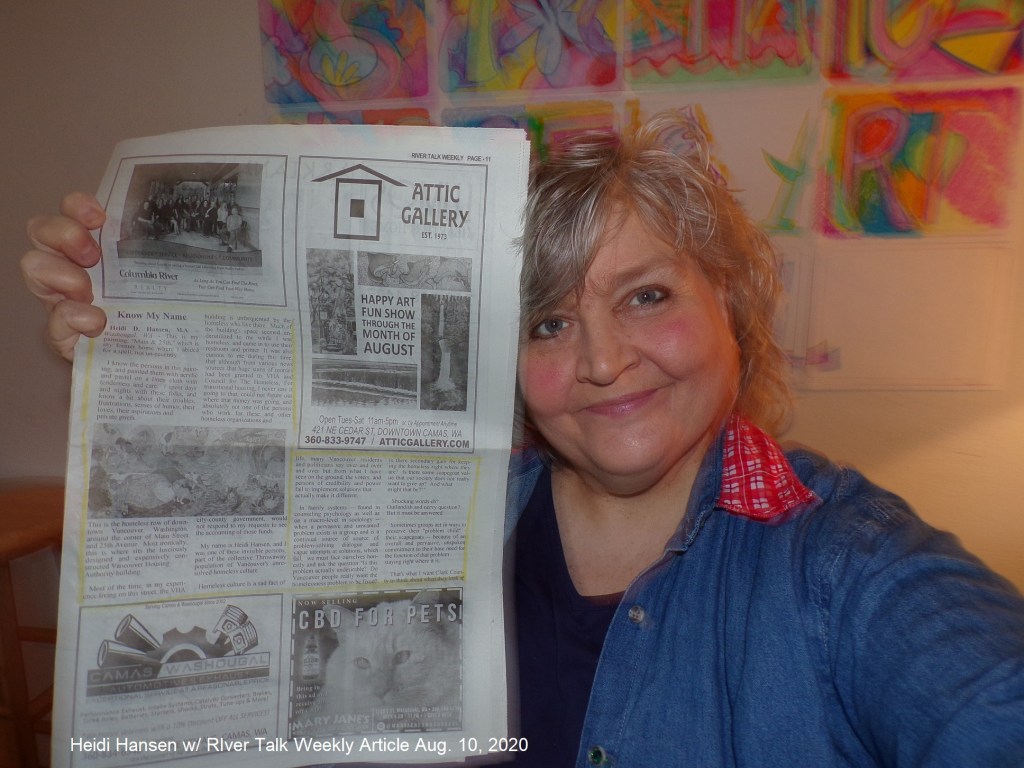
“Know My Name” is a project I propose that recruits a volunteer force of homefull persons who have become sustainable in homefullness culture, and are stable and confident enough to be a mentor, a sponsor, for an up-and-comer homefull person.
A homefullness sponsor does not do social work or donate money or housing itself.
A homefullness sponsor will go through a training with me, (I’ll be the leader and organizer here) and be matched with a sponsee who is willing and determined to not relapse once housing has been achieved.
A homefull sponsee and their sponsor will set out an attainable goal plan to get strong in their identity in their new homefullness culture and get strong in their areas where relapse back into homelessness is a risk or vulnerability.
In other words, a sponsor shows the sponsee the ropes of homefullness culture, walks beside them to guide and support them in building their own new personal identity and by so doing, prevents relapse into homelessness — and instead, finds a meaningful and valued niche, homefull relationships and groups, and becomes useful in homeful culture.
This operates on the premise that we become more like the people we hang out with. If we want certain successful traits and habits, we will get them by spending more time around people who have achieved those success habits and traits
I am inviting interested persons to email me and sign – up to be sponsors, and then I will set up some Zoom meeting trainings to review the expectations, skills, and nuts and bolts of goal setting and communication.
Each week a sponsee will communicate with me to stay on track, while they stay in weekly communication with their sponsee, sharing their experience, strength and hope, motivating and encouraging and celebrating those goals, reinforcing their new positive relationships and activities, and be there for their sponsee when homefullness stress and discouragement hits.
Remember, this is not social work and not monetary. It’s humanity at its own best reservoir for solving a very human set of problems.
Then, I will look for sponsees who want to participate in this project, and match them up with a suitable sponser.
I am asking you, reader, and asking those in social services to help spread the word on this project, and send referrals my way so I can start to organize matches.
This is brand new for me, and brand new for sponsors and sponsees, so this is the time to float your ideas and suggestions and be a part of the building up of this project, if you desire.
I do believe that homelessness relapse can be prevented, and that newly homefull persons can contribute so solidly to their new culture — once they know what that is after living in a marginalized culture — and that this “Know My Name” project can be a viable, life-affirming action with observable, measureable series of viable results.
Interested in helping out?
Please email me at dog.hotel.hansen@gmail.com, or call me at 360-835-8591, room 111 in Washougal to discuss your thoughts, questions and suggestions.
Thank you for your interest and your help.
You can get to know me better by exploring my websites at:
http://www.theartistschronicles.wordpress.com
http://www.thetraumaproject.health.blog
http://www.thementalhealthdetective.wordpress.com
http://www.doghotelbooks.wordpress.com
http://www.themuseacademy.wordpress.com
http://www.nativicabook.wordpress.com
Thanks, and take great care of yourself — you are definitely a great person, and I love it that you read this!
Heidi Hansen
 the trauma project